
Dialogue Persuasion Checks
Whether a line lands depends on your skills—and a little luck.
- Prototype complexity
- Who plays
- Solo decisions
- Design focus
- Information · Risk · Narrative
 No.265Baldur’s Gate 3
01The core loop
Action → feedback → next choice- 01A check option appears
- 02Assess the odds
- 03Roll or resolve
- 04The story branches
↻Feedback changes the situation — the next round starts from there.
Walk through one round
A simplified design example. Situations and numbers illustrate the mechanic, not exact rules from a reference game.
- T1
Turn 1 · The situation
A gatekeeper blocks you. The persuasion DC is 15, your bonus +4, and you have one reroll.
- T2
Turn 2 · The player chooses
You roll 9 (13 total) and fail, so you spend the reroll.
- T3
Turn 3 · The feedback
You roll 14 (18 total); he steps aside and mentions a hidden passage.
- T4
Turn 4 · The next decision
With no rerolls left, failing the coming interrogation means forcing your way.
How it plays
Some dialogue options carry skill checks with visible difficulty or odds. Success opens shortcuts, avoids fights or gains intel; failure may anger the NPC or close a path. Check types, bonuses and retry rules shape when you take the risk.
What the player weighs
- Risky checks may yield the best outcome, or close the line entirely
- Points in social skills mean weaker combat
02Start small
Scope is an editorial estimate for the minimum prototype, not the reference game or a production schedule.
03One mechanic, different implementations
Baldur’s Gate 3
Dialogue checks use a visible-DC d20 roll, with Inspiration for rerolls and bonuses from abilities and proficiency.
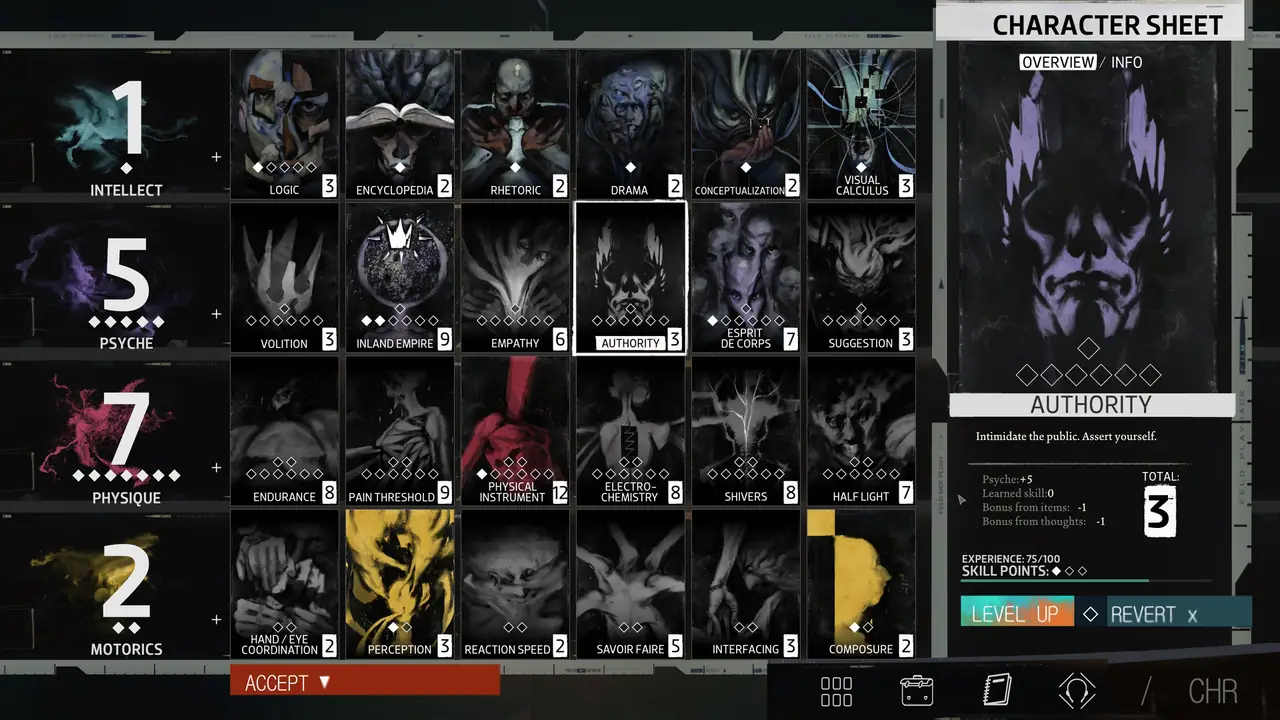
Disco Elysium
White checks can be retried after raising the skill, red checks are one-shot, and passive checks fire automatically in the background.
The difference worth noticing
BG3 follows tabletop rules; Disco Elysium's retry colors make failure itself part of the story.
Case notes are Yoroll editorial summaries; rules may change between versions.
04What could you combine?
Pair with scene deduction: each piece of reconstructed evidence you present adds a bonus to the persuasion roll.
Prototype this combo in Yoroll→Follow the next idea

Secrets as Leverage
Know what someone wants hidden, and they'll start doing what you ask.
- Prototype complexity
- Who plays
- Solo decisions
- 01Investigate a target
- 02Uncover a secret
- 03Expose or blackmail
- 04Live with the fallout

Companion Approval
Your companions watch every choice, and they keep score.
- Prototype complexity
- Who plays
- Solo decisions
- 01Face a choice
- 02Decide
- 03Companions approve or object
- 04Shifts reshape the party
Faction Reputation
Help one side, and the other side remembers.
- Prototype complexity
- Who plays
- Solo decisions
- 01Take a faction job
- 02Complete or betray
- 03Reputation shifts
- 04Gain or lose access