
Keeping Time in the Dark
The screen goes dark and the cues vanish; only your inner beat remains.
- Prototype complexity
- Who plays
- Solo decisions
- Design focus
- Timing · Information · Precision
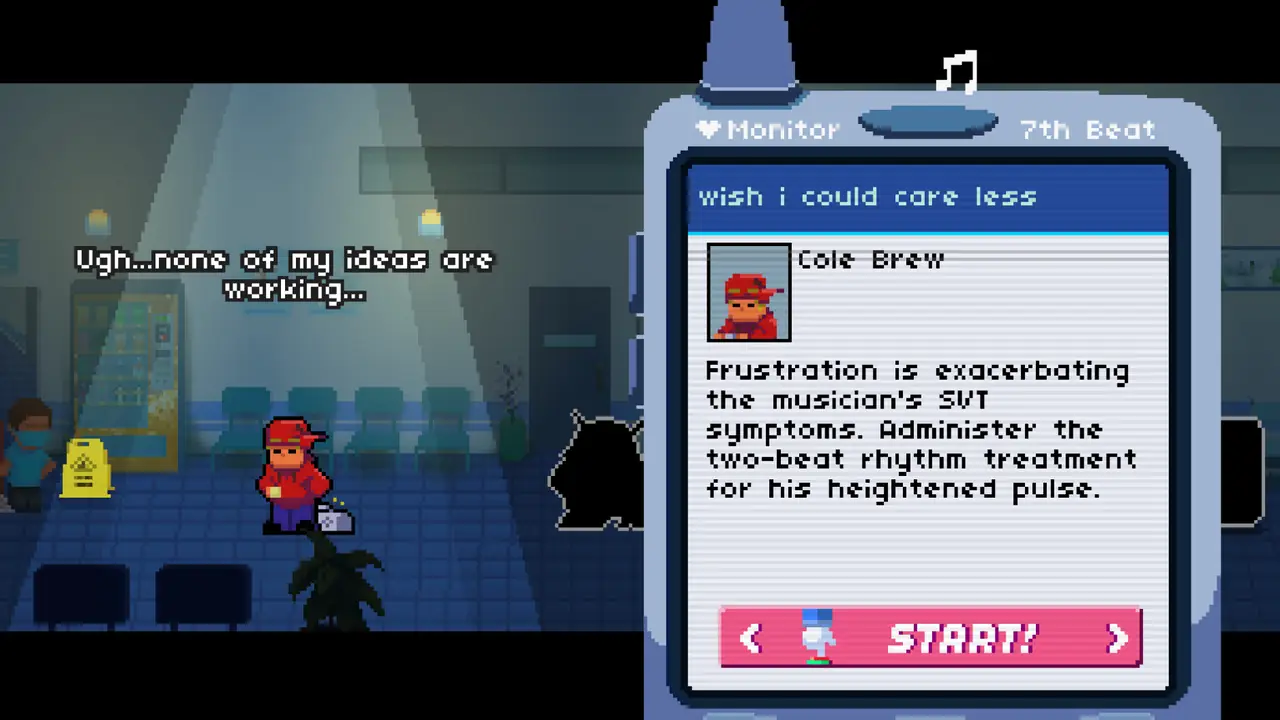 No.209Rhythm Doctor
01The core loop
Action → feedback → next choice- 01Show visible cues first
- 02Cues fade away
- 03Input from memory and music
- 04Cues return to check
↻Feedback changes the situation — the next round starts from there.
Walk through one round
A simplified design example. Situations and numbers illustrate the mechanic, not exact rules from a reference game.
- T1
Turn 1 · The situation
Tempo steady at 120 BPM; the screen dims at bar 16.
- T2
Turn 2 · The player chooses
Close your eyes, follow the kick drum and keep pressing each beat.
- T3
Turn 3 · The feedback
Seven of eight beats correct, one late.
- T4
Turn 4 · The next decision
Visuals return; the next blackout lands during a tempo change.
How it plays
Levels first establish rhythm with visual cues, then hide them via occlusion, blackouts or effects, so players keep inputting from the pulse they've built. Judgment stays the same; only the reference disappears.
What the player weighs
- Lock onto the music or remaining visuals
- Hold steady tempo or adjust on a guess
02Start small
Scope is an editorial estimate for the minimum prototype, not the reference game or a production schedule.
03One mechanic, different implementations
Rhythm Doctor
As I recall, some levels distort the screen, cover rows or make cues invisible, so players must rely on the music to keep time.
Rhythm Heaven Megamix
Some minigames black out or cut away mid-sequence, leaving only audio cues and emphasizing listening.
The difference worth noticing
Rhythm Doctor uses heavy visual effects as interference; Rhythm Heaven uses brief blackouts or cutaways.
Case notes are Yoroll editorial summaries; rules may change between versions.
04What could you combine?
Players carry limited light items that briefly restore cues; once spent, they must keep the beat in darkness.
Prototype this combo in Yoroll→Follow the next idea

Cue and Response
The cue sets the pattern; you press on the beat it leaves unsaid.
- Prototype complexity
- Who plays
- Solo decisions
- 01Hear the cue pattern
- 02Count to the target beat
- 03Input on the target
- 04Get feedback and adjust

Holding the Long Note
Pressing is easy; holding until the very last beat is the challenge.
- Prototype complexity
- Who plays
- Solo decisions
- 01A long note appears
- 02Press on time
- 03Keep holding
- 04Release at the end

Moving on the Beat
Every step and strike lands on the beat; the music is your turn timer.
- Prototype complexity
- Who plays
- Solo decisions
- 01Hear the beat
- 02Input on the beat
- 03Gain a bonus or penalty
- 04Plan the next beat