
Read Between the Orders
Customers never say exactly what they want; you piece it together from hints.
- Prototype complexity
- Who plays
- Solo decisions
- Design focus
- Information · Creativity · Narrative
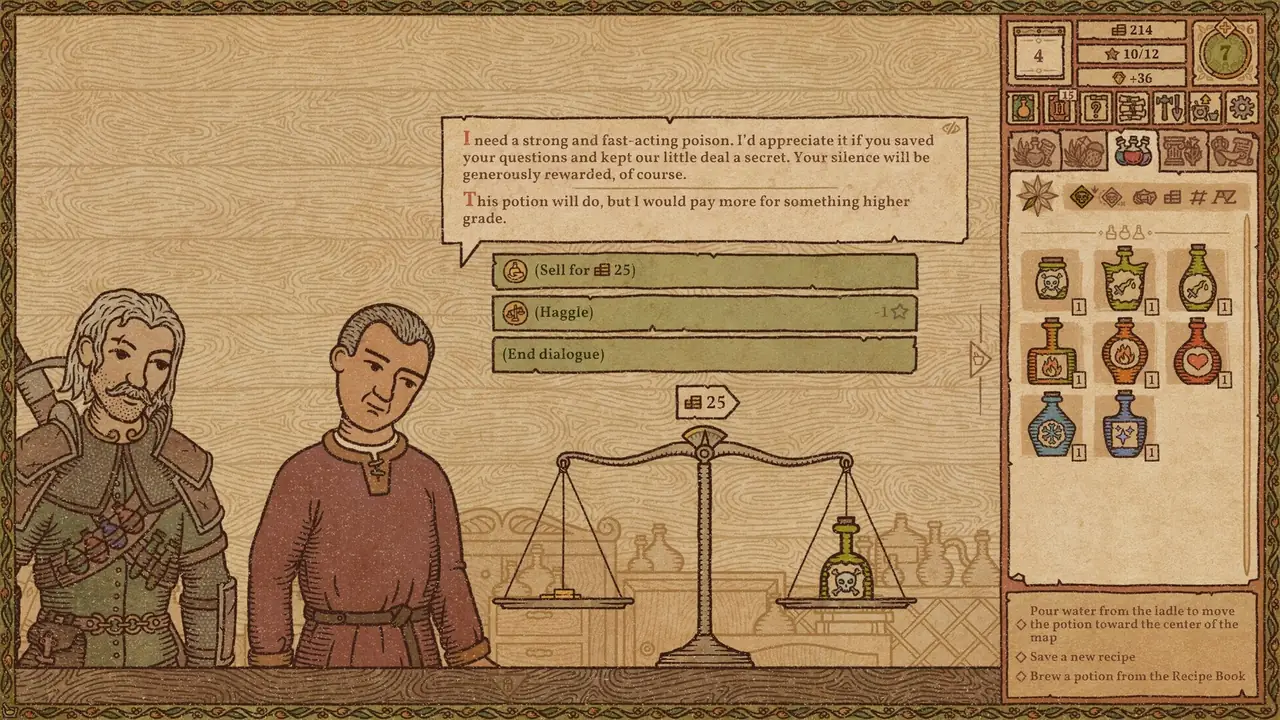 No.276Potion Craft: Alchemist Simulator
01The core loop
Action → feedback → next choice- 01Customer describes a need
- 02Parse the clues
- 03Craft or pick an item
- 04Satisfaction feedback
↻Feedback changes the situation — the next round starts from there.
Walk through one round
A simplified design example. Situations and numbers illustrate the mechanic, not exact rules from a reference game.
- T1
Turn 1 · The situation
A customer says ‘I want to sleep early tonight, nothing exciting’; you have a sleep tonic and a strong stimulant.
- T2
Turn 2 · The player chooses
Reading calm, the player hands over the sleep tonic.
- T3
Turn 3 · The feedback
The customer is pleased, pays 120 and leaves a good review.
- T4
Turn 4 · The next decision
The next request is vaguer and needs more thought.
How it plays
Orders arrive as loose descriptions; players extract attributes and match them to recipes or goods. Right answers pay in full, near misses pay less, and wrong guesses can hurt reputation or story. The customer’s reaction line is the clearest feedback.
What the player weighs
- Literal reading vs reading subtext
- Make the ideal item vs settle with stock
02Start small
Scope is an editorial estimate for the minimum prototype, not the reference game or a production schedule.
03One mechanic, different implementations
Potion Craft: Alchemist Simulator
Customers describe problems in plain speech, and you deduce the effect needed before brewing it on the alchemy map.

VA-11 Hall-A: Cyberpunk Bartender Action
Patrons sometimes name a drink and sometimes only describe a taste or mood; your mix, size and strength steer the conversation.
The difference worth noticing
Potion Craft’s interpretation feeds a crafting system; VA-11 Hall-A’s feeds narrative and relationships.
Case notes are Yoroll editorial summaries; rules may change between versions.
04What could you combine?
Players bring a limited set of recipe cards each day, predicting the crowd’s needs to build a fitting loadout.
Prototype this combo in Yoroll→Follow the next idea
Know Your Max Bid
Holding your limit while others raise the bid is the hardest auction lesson.
- Prototype complexity
- Who plays
- Solo decisions
- 01Appraise the lot
- 02Set a personal cap
- 03Raise or drop out
- 04Win it or let it go
Find the Right Price
Not sure what it’s worth? Set a price and read the customer’s face.
- Prototype complexity
- Who plays
- Solo decisions
- 01Tag a price
- 02Watch the reaction
- 03Note the range
- 04Adjust next time

Cooking to the Judge
Judges have tastes, and your dish must hit them as closely as possible within the time.
- Prototype complexity
- Who plays
- Solo decisions
- 01Learn the judge's tastes
- 02Pick and combine ingredients
- 03Tune the flavor balance
- 04Serve and get scored